
Peering into the Cosmic Dawn: The Revolutionary Gaze of the James Webb Space Telescope 🚀🌌
Unveiling the Universe's Hidden Secrets
For centuries, humanity has gazed at the night sky, driven by an insatiable curiosity about our place in the cosmos. Telescopes have been our eyes to the universe, each generation pushing the boundaries of what we can see and understand. Now, we have a new champion in this quest: the James Webb Space Telescope (JWST). This marvel of engineering is not just another telescope; it's a time machine, a window into the early universe, and a powerful tool for unraveling some of astronomy's biggest mysteries.
Launched in December 2021, the JWST is the successor to the iconic Hubble Space Telescope, but with significantly enhanced capabilities. Its primary mirror, composed of 18 hexagonal segments of beryllium coated in gold, boasts a staggering 6.5-meter diameter, dwarfing Hubble's 2.4-meter mirror. This larger size allows JWST to collect much more light, enabling it to observe fainter and more distant objects.
Infrared Vision: Seeing the Unseen
One of JWST's key advantages is its ability to observe primarily in the infrared spectrum. Unlike visible light, infrared light can penetrate the clouds of dust and gas that often obscure our view of celestial objects. This allows JWST to peer into stellar nurseries where stars and planets are born, and to study the light from the very first galaxies that formed after the Big Bang. This capability is crucial for understanding the universe's early history.
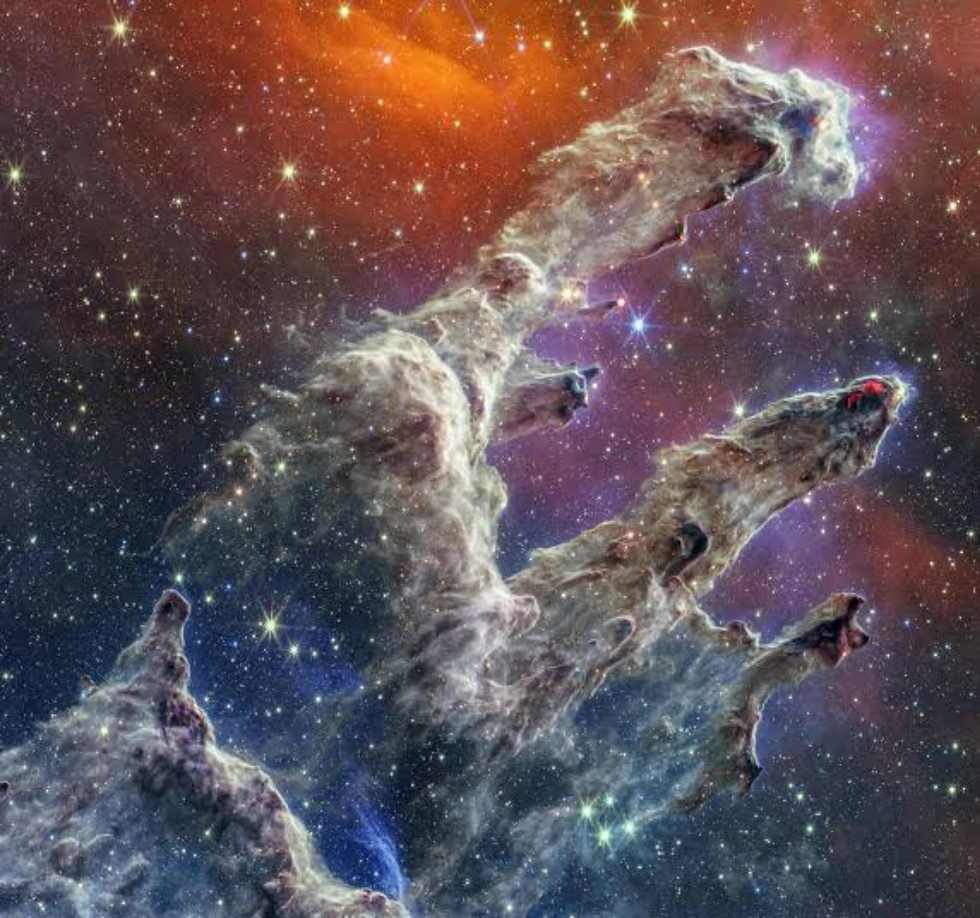
Stunning Discoveries and Breathtaking Images
Since its first images were released in July 2022, JWST has delivered a constant stream of awe-inspiring visuals and groundbreaking scientific data. Some of the highlights include:
Deep Field Views: JWST has captured the deepest and sharpest infrared images of the distant universe ever taken, revealing thousands of previously unseen galaxies. These images offer invaluable insights into the early stages of galaxy formation and evolution.
Exoplanet Characterization: JWST is revolutionizing our understanding of planets beyond our solar system (exoplanets). It can analyze the atmospheres of these distant worlds, searching for the chemical signatures of water, carbon dioxide, and even potential biosignatures – hints of life.
Stellar Nurseries and Planetary Systems: JWST's infrared vision allows us to witness the birth of stars and the formation of planetary systems in unprecedented detail. We can now study the dusty disks around young stars where planets are coalescing.
Galactic Evolution: By observing galaxies at different distances (and therefore at different points in cosmic history), JWST is helping scientists understand how galaxies grow, merge, and evolve over billions of years.

A Collaborative Triumph
The James Webb Space Telescope is a testament to human ingenuity and international collaboration. It's a project led by NASA, with significant contributions from the European Space Agency (ESA) and the Canadian Space Agency (CSA). The data collected by JWST is available to scientists worldwide, fostering a global effort to explore the cosmos.

The Future is Bright (and Infrared)
The JWST has only just begun its mission, and it promises many more years of groundbreaking discoveries and stunning imagery. It's poised to answer some of the most fundamental questions about the universe, from the formation of the first stars and galaxies to the potential for life beyond Earth. As we continue to receive data from this incredible telescope, our understanding of the cosmos will undoubtedly undergo a profound transformation. The era of the James Webb Space Telescope is truly a golden age for astronomy!


Comments